
For a long time now, I’ve had too many interests and not enough time — too much to read, learn, make, see, and a list that grew faster than I could move through it.

It came to a point where I was so overwhelmed that I’d give up and scroll through my phone instead, because it was easier than deciding what to do.
Annual resolutions had worked before — even a three-year horizon planning. But as the list grew, those longer time horizons would flatline energy and I’d quit. And quitting felt like I was letting myself down, so I stopped planning altogether.
For a while, the pure spontaneity was a relief. But over time, the harder, more meaningful things never got off the ground. They still needed some kind of structure around them.
So I found myself stuck — on one hand, spontaneity left my interests underdeveloped. On the other, a long commitment felt permanent and ending it early felt like failure.
The solution came in the form of a “12-week year” — a system from Brian P. Moran and Michael Lennington’s book of the same name (which found its way to me through Chani’s podcast).
The premise is simple: Instead of treating a calendar year as the basic unit of planning, you treat twelve weeks as a whole year.
This twelve-week container solved both problems. It’s short enough that the end is always in sight, and long enough to do something substantial. The spontaneity lives in choosing what feels alive enough to prioritise in the next twelve weeks. And the perceived permanence is lower because there’s a built-in way out.
I’m currently on week 10 of my third 12-week year. I set two goals this round. The first was to publish six posts here; this is the sixth — so that’s going well.
The second was to work through a self-made curriculum on a topic I care about. It went well until the halfway mark, then stalled, and will probably stay parked for a while. That’s less than I’d hoped.
The surprise is: I’m somehow okay with it.
As a recovering perfectionist, leaving something open, unresolved, with no known plans to complete? And being okay with that? That’s the real win. Possibly bigger than the goal I’m actually landing.
What I love about this system is that the 12-week boundary — the same container that insists on prioritising one or two goals — is also helping me get the reps in to stop, pause, leave things unfinished, and (*gasp*) actually celebrate what I accomplish.
What follows is how it actually works, and how I’ve adapted it to support me - rather than letting it become yet another standard to beat myself up with.
The basics
As I mentioned earlier, the idea is to treat twelve weeks as a whole “year” and set one or two real goals for it.
Then, each week, protect some time to work on these goals and hold a short check-in — to see how the past week went and plan the one ahead.
Over a full calendar year, there are four 12-week years, with a free week between each. This free week is to celebrate what you’ve accomplished.
Why twelve weeks
A calendar year leaves too much room for drift. In January, or even June — December feels far enough off that there’s always the feeling of “oh, there’s plenty of time to start.” So the weeks float by, and the year drifts.
Twelve weeks is close enough to change that. The end stays in view — near enough that it can’t be ignored, but not so near that it collapses into anxiety. That distance builds momentum: each week actually counts, and a week that counts is much harder to simply drift through.
Before you start: vision, and choosing goals
The book opens with vision-setting — imagining the life you want vividly enough, the feeling of it, that you can draw energy from it when things get hard.
Instead of writing mine down, I make collages (more on that another time). Intuitive collaging surfaces what I want, and how I want to feel, faster and more honestly than just writing about it. I don’t do it every 12-week year, but for the big identity-shifting goals it noticeably raises the odds that I’ll show up for the hard parts.
Then comes choosing the goals themselves. The book treats this briefly; three 12-week years have revealed to me that my goals tend to fall into one of four categories, each with its own shape:
Major / identity-shifting goals
What they are: High stakes, high reward — the things that push your growth edges. These are the ideas that keep returning as “this would be pretty cool to do”. You want them, but you know they’ll be hard.
Examples: A sustained public writing practice; A self-produced solo talk at a meetup
Shape: An intention works better as the anchor than a strict target: “keep my connection to writing alive,” not “write 500 words a day.” A flexible shape is what keeps the intention alive and lets momentum build — for a writing practice, that means two hours of editing counts the same as one good metaphor.
Experimental goals
What they are: Lower-stakes, behind the scenes. A skill to build, a practice to try. Droppable any time — the point is to try on the costume before deciding whether to keep it. A successful outcome is just data collection.
Examples: An hour a week using AI tools; Building video editing skills, via a 1–2 min vlog published 3×/week
Shape: A targeted goal works well: “do [the thing], X times a week, for the next 4 / 6 / 12 weeks — and review: what felt good? what felt worth keeping? and in what shape?”. The fixed container is what keeps the experiment exploratory.
One-off goals
What they are: Contained, one-time. Most of my life-admin and travel goals land here.
Examples: Reorganise my art supplies; Be present with family on a trip.
Shape: Simple to set — and, like the big goals, an intention at the centre wins over a strict target.
Maintenance goals
What they are: Low-effort, general life improvement. Also where successful experiments graduate once they’re becoming more habitual.
Examples: Walk 4×/week; Charge my phone overnight in another room.
Shape: Like experiments, a targeted goal — X, Y times, for Z weeks. Best for things you want to become automatic — habits, not practices (more on than distinction here).
Choosing goals
I usually set one major goal, one experimental goal, sometimes a one-off goal, and 2-3 maintenance goals per ‘year’. When time’s tight, I only focus on the primary and pause or stop the rest.
Picking the right goals matters. And the right goals are usually already present in your life. In my first 12-week year, my parents were visiting for a month, and I made being present with them an explicit goal — right beside giving a public talk. Naming both changed the whole month. Without it, the talk would have been “the work,” and the time with family would have quietly become overhead, something I might even have low-key resented without knowing why. Instead, both were goals I wanted to give attention and time to.
Getting clear on the emotional centre of how you want life to feel is most of the work of choosing well.
For planning, I diverge from the book slightly. I don’t break down each goal and then map out activities week by week. I plan for about 2-3 weeks ahead, but more importantly, I use planning time for a reality check against my actual calendar: given what’s coming — work, relationships, travel — can I realistically carve out time for this? It tells me what’s achievable, and gives me permission to say not this time to the rest.
Running the week
A few rituals keep a 12-week year alive —
Time blocks
There are three kinds of time blocks, every week:
A long deep-work block (~3 hours) — for me, this is half a day at a café on the weekend.
A few short blocks to keep momentum — currently, this tends to be the quiet hours before work or after dinner, a few times a week.
A breakout block that has explicitly nothing to do with productivity (at least 3 hours) — I’ve been using half a day on the weekend to turn into a tiny adventure for this block.
Weekly check-ins
This is one short weekly check-in that does three things:
Accountability check: taking honest stock of how the previous week went
Reflection: looks at whether there gap between plan and reality, and why
Planning for next week: what’s looking realistic (I plan to about 70% of available time, never to the brim)
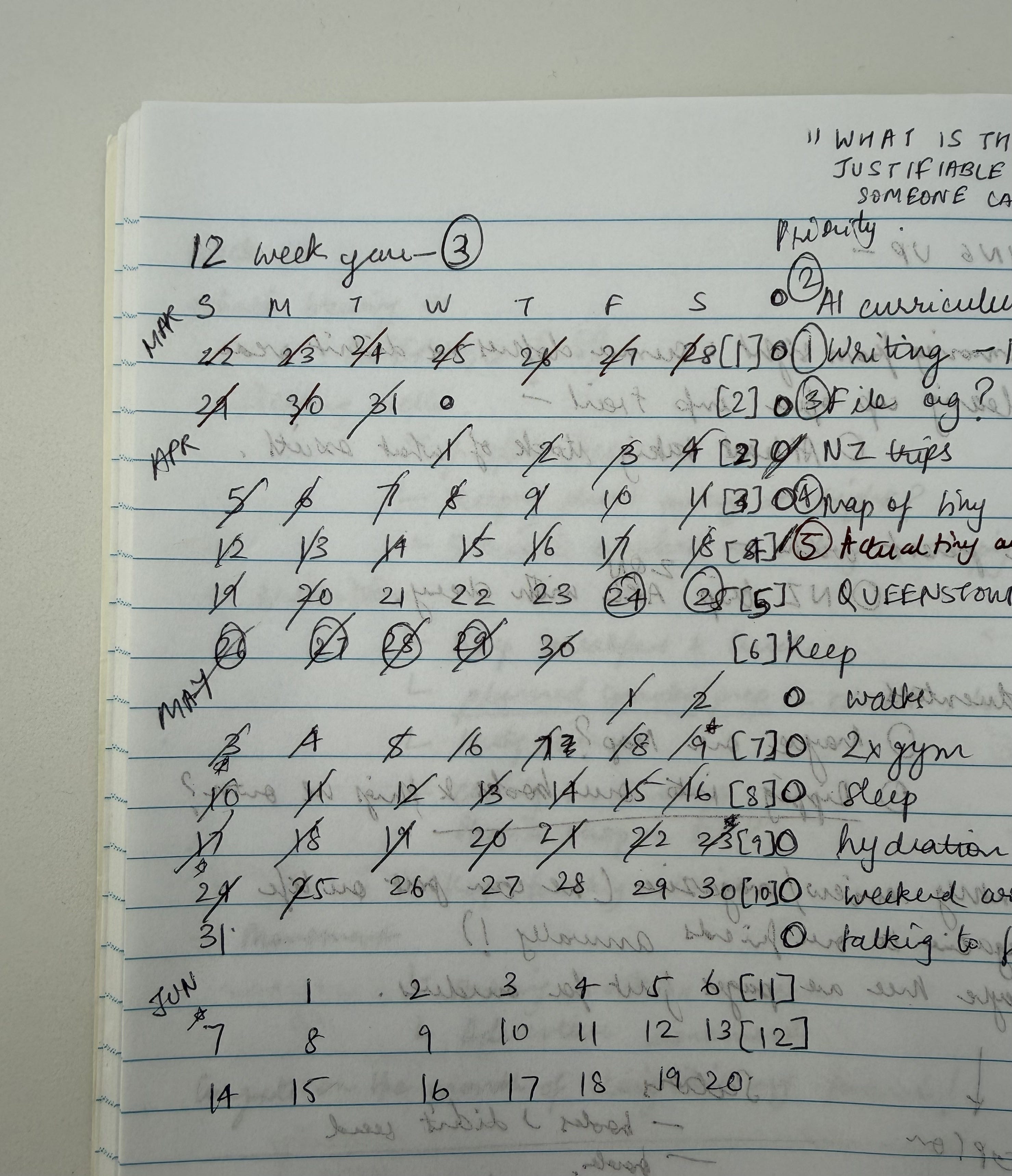
For the accountability step, I keep a simple notebook to track my 12 weeks. And the planning step helps me put things down pre-emptively and guilt-free when there were other demands on my attention.
The reflection step, however, can easily trigger my perfectionism, so I’ve had to learn how to do it gently. The point is not to interrogate myself about why I didn’t do enough. It’s to look at the gap between plan and reality with honesty and kindness. What got in the way? Was the plan too ambitious? Did something matter more that week? Was there resistance, and if so, what was it trying to protect?
I try to review the week from the perspective of someone who loves me and is cheering for me, especially when I’ve fallen short. This shift uncovers the goal under all goals - learning how to work with resistance without turning on myself.
These check-ins are what kept the structure and momentum sustainable. For identity-shifting goals, doing a check-in with an accountability buddy was, on some days, the only thing that got me to show up for ten minutes. The value wasn't in someone asking "why you didn't" — but in having someone witness the journey.
The book also talks about defining and tracking leading-and-lagging metrics to monitor. I understand why, but it’s not something I’m personally drawn to. I prefer time-based metrics over outcome-based ones — they keep the focus on showing up, not on the result.
A mid-year check-in
In addition to these weekly rituals, the one thing I have added is: a mid-year check-in around week six. I’ve noticed some experiments tend to lose steam at that point and it’s a good time to ask whether each goal still feels alive, and is worth recommitting to or releasing fully.
The free week
After twelve weeks, it’s time to stop. Take a break. A full free week — to do nothing toward any goal except notice what landed and let it count.
The first time I did this, it felt deeply strange — almost uncomfortable. I wasn’t used to stopping on purpose, and it showed me how little I’d ever let myself celebrate. A week turned out to be the right size: long enough that the work doesn’t just slide past, short enough that it never tips into restlessness. Now, by the thirteenth week, I get a feel for what’s gathering momentum for the next 12-week year. And while I keep a running list of things I want to try, I’ve only ever opened it to add to it, I haven’t needed it to choose yet.
Keeping the 12-week years going
I now line up my 12-week years with the solstices and equinoxes, which has deepened my connection to the natural progression of seasons. Over time, it has started to make planning feel less like a box-checking exercise and more like a rhythm of life: choose, tend, stop, notice, begin again.
If you want to do a lot, but run hot — always one good stretch away from burning out — this system is worth trying. Not because it will help you squeeze more out of yourself, but because it gives your energy and interest somewhere to go. It lets you begin something without pretending you’ll do it forever. And just as importantly, it builds in the check-ins and stopping points.
For me, it’s become something to lean on while the pausing, leaving unfinished, and celebrating feel safe enough to come on their own.
I love this! I read The 12-Week Year but struggled to implement it. You have done such a nice job of laying out possibilities for making it work. Thank you for sharing!
I loved this article so much. As someone who has many different interests, I think I should definitely try setting goals for 12 weeks. I've been so confused over the past two weeks about what I should do with my life and how to choose something to start or continue. Now, I feel like I have a clearer mind, which I can use to plan things much better.